
The $19 advert is a trip fee, not a price
The number in the advert is real. It is just not the price of anything. Nineteen dollars buys a van arriving; the opening, the labour and whatever the technician decides your lock is are all separate lines, and none of them were mentioned on the phone. By the time you hear them you are standing on your own porch at eleven at night with somebody already kneeling at your door, which is the exact moment when arguing feels harder than paying.
The scale of the gap is easy to check against published figures rather than opinion. Independent surveys of San Jose pricing put the call-out fee alone at $56 to $112 and a house lockout at $100 to $240, averaging around $168. A long-established local firm publishes $65 to $100 in daylight and $100 to $150 after hours for the same job. Our own published range is $118 to $209 with the $89 service call already inside it. Every one of those numbers is at least three times the advert. Nobody in this city opens doors for nineteen dollars, because nobody can.
That is the whole mechanism. The advert is not competing on price; it is competing for the first click, and the actual price is set at your door once you have stopped shopping. The defence is not finding a cheaper advert. It is refusing to accept any figure that is not a whole figure.
Ask for the whole figure, then ask what could change it
One question sorts most of it: what is the total for this job, including the call-out and any night rate. A real locksmith can answer that from a description of your door, because after a few thousand jobs the variables are known. If the answer is a range, that is fine, and the honest version is a narrow one — $118 to $209 for a house lockout is a range you can plan around. If the answer is "starting at" and nothing else, you have been given a marketing figure, not a price.
Then ask the second question: what would make it more than that. The honest answers are specific and short — a high-security cylinder, a second locked door behind the first, a keypad that has to be bypassed and then made to work again. The dishonest answer is vague: it depends what the technician finds. That sentence is the whole scam in six words, because the technician will find whatever the job needs to be worth.
Finally, ask what the night rate is and whether it is already inside the figure. In this city the evening and overnight tiers are real: our own are $40 between 8pm and midnight and $75 between midnight and 7am, which is why the $118 opening reads $158 in the evening and $193 after midnight. Those tiers are counted in before the number is said. A company that will not tell you the night rate on the phone is a company planning to discover it later.
The out-of-state call centre problem
A large share of the "San Jose locksmiths" in search results are not locksmiths and are not in San Jose. They are lead brokers: hundreds of near-identical listings, stock photographs, and a local-looking number that routes to a call centre in another state, which auctions your job to whoever is nearest with a van and a drill. The person who arrives has no relationship with the person who quoted you, which is precisely why the two figures do not match.
You can spot it in the first fifteen seconds. Ask what the company is called and listen to whether you get a name or a phrase like "the locksmith service". Ask where they are based. Ask for the technician's name before they arrive. A dispatcher working from a real rota can give you all three; a broker cannot, because the job has not been sold yet.
The tell after the call is just as clear. A real firm texts you a name, and often a photograph, before anyone knocks. If the first time you learn who is coming is when they are standing in front of you, your job was sold rather than scheduled.
Drilling is rare, and agreeing to it should never cost more
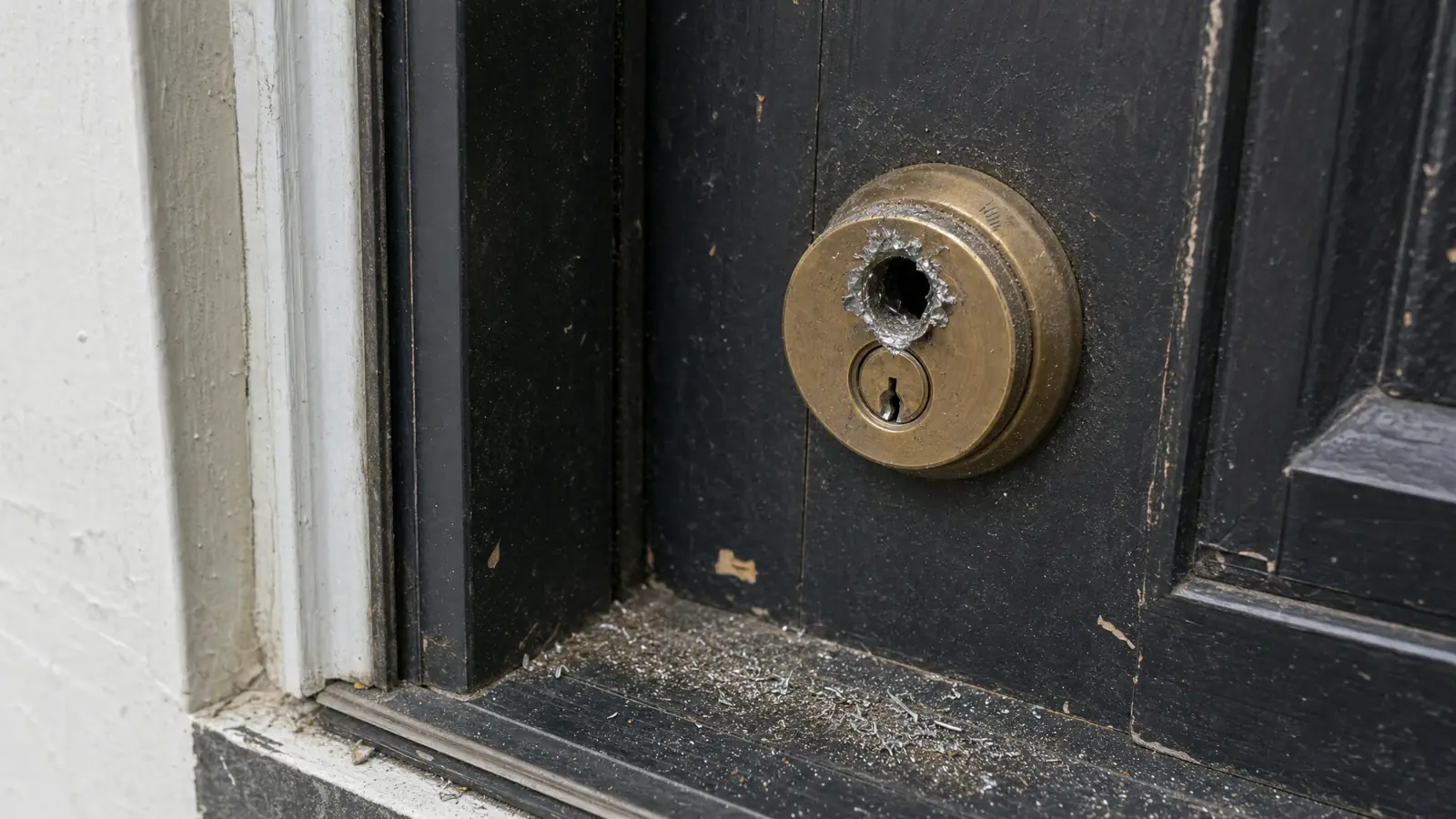
The overwhelming majority of residential locks in this city open with picks and decoders in a few minutes. Drilling is a last resort for a small number of high-security cylinders, and it is a decision, not a discovery: you should hear why it is necessary, what the replacement will be, and what the whole thing now costs, before anything touches the lock. And the figure should not move because you said yes.
The scam version runs the other way. The drill comes out early because it is fast and because a destroyed lock has to be replaced, which is where the money is. If someone reaches for a drill in the first two minutes on an ordinary deadbolt, that is the moment to stop the work. You are allowed to. It is your door.
Old hardware deserves a mention here because San Jose has a great deal of it. Willow Glen and Naglee Park keep original mortise locks, and the tract ranches in Cambrian and Blossom Valley still wear sixty-year-old knob sets. Those open more easily than modern locks, not less — the pins are worn smooth. A technician who wants to drill one has told you something about themselves.
Cash-only, no invoice, no company name on anything
The ending of the classic scam is a demand for cash, or a card machine that is suddenly broken, and no paperwork of any kind. That is not a payment preference. It is the removal of every record that the transaction happened, which is what makes the previous forty minutes unappealable.
The counter is boring and effective: pay by card, and expect an itemised invoice by email with the company name on it, showing the visit, the labour and any parts as separate lines. If you are a tenant, that invoice is what your landlord will want. If you have had a break-in, it is what your insurer will want. If neither applies, it is still the thing that proves what you were charged for.
Keep the old parts, too, where parts were changed. On a rekey the old pins should come back to you in a bag; on a lock replacement the old lock should be handed over rather than pocketed. It is not sentimental. It is the only evidence that the work described was the work done.
Sixty seconds of checks, in order
Ask the company name and listen for a name, not a category. Ask for the whole figure including call-out and night rate. Ask what would change it, and expect specifics. Ask for the technician's name before arrival. Say you will pay by card and want an emailed invoice. Any company that goes quiet at one of those five is telling you what the next hour would look like.
Two extras worth thirty seconds each. Search the phone number itself rather than the company name: brokers reuse numbers across dozens of listings, and the results will show you that. And look for a published price list rather than a page of adjectives. In our survey of nine San Jose locksmith websites, six published no figures at all — one of them advertised "$29 locksmith" in its page title and had not a single price in the body of the page.
If you are already mid-job and it has gone wrong: stop the work, say plainly that you did not agree to that figure, ask for an itemised invoice, and pay by card if you pay at all, because a card payment can be disputed and cash cannot. Take a photograph of the van and the licence plate. Then report it — the state licensing board and the city both take these, and the reason the same listings persist for years is that most people are too tired at midnight to file anything.
Quick answers
Is a $19 or $29 locksmith advert always a scam?+
Not always illegal, but always incomplete. That number is a trip fee, and the opening, labour and parts sit on top of it, unnamed until the technician is at your door. Published surveys put the real San Jose call-out at $56 to $112 and a house lockout at $100 to $240. Ask for the whole figure on the phone and the advert stops mattering.
How can I tell a local locksmith from an out-of-state call centre?+
Ask three things: the company name, where it is based, and the name of the technician who will come. A real dispatcher answers all three from a rota. A broker cannot answer the third at all, because your job has not been sold yet. A firm that texts you a name and photo before arrival is not a broker.
The technician wants to drill my lock. Should I let them?+
Only after you have heard why, what the replacement will be and what the total now is — and the total should not rise because you agreed. Most residential locks in San Jose open with picks in minutes, and the older hardware in Willow Glen or Cambrian opens more easily than modern locks, not less. A drill in the first two minutes on an ordinary deadbolt is a reason to stop the work.
What should I do if I have already been overcharged?+
Pay by card rather than cash so the payment can be disputed, insist on an itemised invoice with the company name, and photograph the van and plate. Then file a complaint with the state licensing board and dispute the charge with your bank. Both are worth doing even when it feels late: the same listings survive for years because almost nobody files at midnight.
Need it handled instead of read about?
(408) 583-5689