
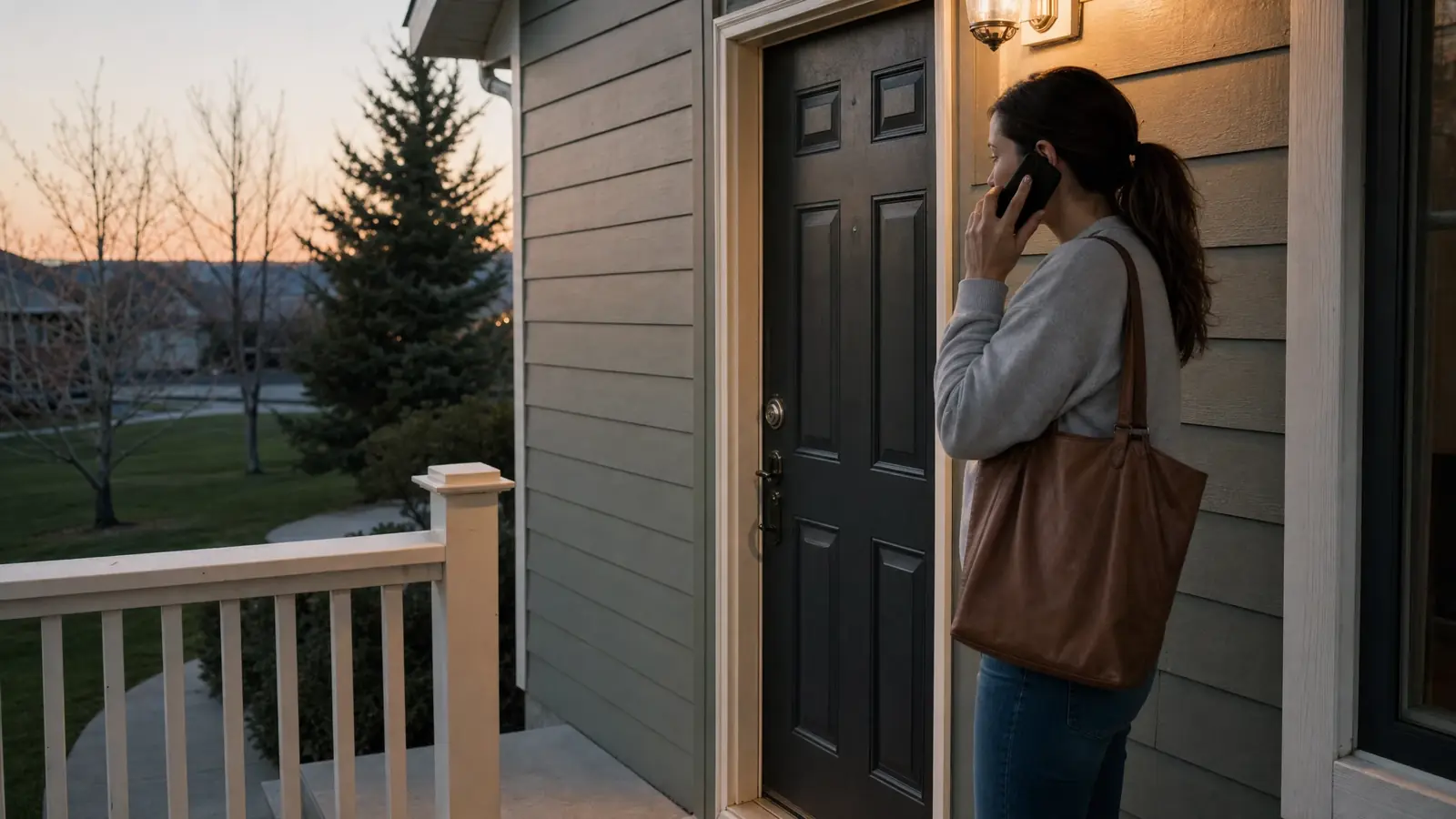
Two minutes of free checks first
Before anything costs money: walk the whole house. Not the front door — the whole perimeter. The back door onto the garden, the side door into the utility room, the door from the garage into the kitchen, and every ground-floor window on the side nobody uses. In this city the garage-to-house door is unlocked far more often than people expect, because most households treat it as an interior door, which is also why it is worth a deadbolt later.
Then the human options. A partner, a housemate, a parent, the neighbour who has been watering your plants since 2019 — a spare key ten minutes away beats any locksmith on price and speed. If you rent, ring the building manager or the leasing office before you assume they are shut; many complexes here run an on-call number after hours, and a manager with a master key costs nothing.
One safety exception overrides all of the above. If a child or a pet is shut inside, especially in a warm house or a car in the sun, stop reading and call 911. That is not the moment to be economical, and any locksmith worth the name will tell you the same thing on the phone.
Do not kick the door, and do not use the card trick
The credit-card trick works on a spring latch and only on a spring latch — a door with a deadbolt thrown is not going to open that way, and what usually happens is a ruined card and a scratched door edge. If your door does open to a card, that is not good news: it means the latch has no auxiliary bolt doing its job, and somebody with a plastic sheet can do the same thing at three in the morning. That is worth fixing whether or not you get in tonight.
Kicking is worse. A kicked door rarely opens, because what gives way is the jamb rather than the lock, and then you are paying for post break-in repair at $165 to $415 — the split jamb, a box strike, the door made square again — on top of the opening you needed anyway. The same is true of putting a shoulder into a uPVC or aluminium frame, where the damage lands in the frame rather than the timber.
Windows deserve a word too. A ground-floor window that has been left unlatched is fair game if you can reach it safely. A window that has to be broken is a locksmith call plus a glazier call, which is always more than the locksmith call on its own, and going in through one at height is how a locked-out evening becomes an ambulance.
What it costs at each hour, and why
A house opening in San Jose is $118 to $209 with us, and the $89 service call is inside that rather than added to it. What moves you within the range is the door: a ground-floor deadbolt in daylight sits at the bottom; a high-security cylinder with spool pins, a second locked door behind the first, or a dead keypad that has to be bypassed and then made to work again sits at the top.
Then the clock. Between 8pm and midnight there is $40 on the job, so a $118 opening reads $158. Between midnight and 7am there is $75, so the same opening reads $193. Those tiers are counted into the number you are told on the phone; they are not discovered on the invoice. Anybody who cannot tell you the night rate before dispatching is planning to tell you afterwards.
For context on whether that is a fair market figure: independent surveys of San Jose pricing put a house lockout at $100 to $240, averaging about $168, with a call-out fee of $56 to $112 inside it, and a long-established local firm publishes $65 to $100 in daylight against $100 to $150 after hours. The adverts promising $19 or $29 are quoting the trip and nothing else.
What to say when you ring
Five things, in this order. Where you are — full address, and the unit or building letter if there is one. What is locked — the front door, the back door, a flat door behind a lobby you can still get into. What kind of lock, roughly: a knob, a deadbolt above it, a keypad, or an old mortise lock with a big key. Whether anyone or any animal is inside. And whether you can prove you live there.
That last one is not optional and it is the point at which a real locksmith and a scam listing diverge. Photo ID with the address is easiest. A lease on your phone works, even in a housemate's name, if that person can text confirming you. A utility bill, a bank letter, a piece of post — all fine. If nothing at all names you at that address, the technician can still work with a landlord or property manager agreeing on speakerphone. Somebody who does not ask this question of you did not ask it of the last person standing at your door either.
Then ask your own questions, because this is the moment you have leverage and forty minutes from now you will not: what is the total including the night rate, what could change it, what is the technician's name. A firm that answers all three and texts you a name before arrival is not going to rewrite the figure at your porch.
Once you are back inside
Ask what the technician found. A door that opened in ninety seconds with a rake is a door that will open in ninety seconds for someone else, and an honest answer to that is worth more than the invoice. On older San Jose stock — the Willow Glen bungalows, the Cambrian ranches — the common finding is a cylinder polished by sixty years of use, and the choice is a fresh pinning at $26 to $42 or a replacement at $115 to $295, with the wear shown to you rather than described.
Deal with the spare properly. A key under a plant pot or on the door frame is the first place anyone looks; a key with a neighbour costs nothing and has no downside. If you would rather not depend on anyone, a keypad on the door your household actually uses runs $182 to $455 fitted, and the sensible one to convert is usually the garage-to-house door rather than the ceremonial front one.
And if your keys were lost rather than left inside, think about what was on the ring. A parking permit, a gym tag, a letter in the same bag — anything that names your address turns a lost-key problem into an address problem, and rekeying every exterior cylinder at $26 to $42 each is the cheap end of that answer.
Quick answers
How much does it cost to get back into my house in San Jose?+
$118 to $209 with the $89 service call already inside the figure. Between 8pm and midnight add $40, so a $118 opening reads $158; between midnight and 7am add $75, so it reads $193. Both tiers are counted in before the number is said on the phone rather than appearing on the invoice.
Will the lock be damaged?+
It should not be. The overwhelming majority of residential doors here open with picks and decoders, and old hardware often opens faster than new because the pins are worn smooth. Drilling is a last resort for a small number of high-security cylinders, and it happens only after you have heard why, agreed to it, and been told the replacement plan — and agreeing does not raise the price.
What if I cannot prove I live there?+
There is usually a way. Photo ID with the address, a lease on your phone even in a housemate's name with a text from them, a utility bill, or a landlord confirming on speakerphone all work. What will not happen is a door being opened on your word alone, and that rule is the same one that stops somebody else standing at your door tonight.
Can I just break a window? It looks cheaper.+
It is not. A broken window means a glazier as well as the locksmith, and a kicked door means post break-in repair at $165 to $415 for the jamb and the strike on top of the opening you still need. The only version that saves money is a ground-floor window you can reach safely that was already unlatched.
Need it handled instead of read about?
(408) 583-5689